1
A university put a berry head to head against the eye vitamin. The berry won.
Researchers at UC Davis ran a randomized trial, published in the journal Nutrients. One group ate a small handful of goji berries five mornings a week. The other took a lutein and zeaxanthin supplement, the same nutrients in the AREDS2 box, in a capsule. Ninety days later they measured the macular pigment in everyone's eyes, the protective layer at the center of your sight. In the berry group, it went up. In the supplement group, it didn't move. The whole food did what the isolated pill could not.
2
No food on earth carries more of the pigment your macula is made of
The center of your sight sits behind a shield of two pigments, lutein and zeaxanthin, a pair of sunglasses built into the eye, filtering the blue light that ages it. Your body can't make either one, so you eat them or the shield runs thin. Zeaxanthin, the one packed into the dead center where trouble starts, is the rarest in the modern diet, and goji berries are the single most zeaxanthin-dense food on the planet, with lutein riding right alongside it.
3
"Watch and wait" is not a treatment. It's a waiting room.
There's no money in telling you to eat a berry. There's money in the scan, the follow-up, the branded vitamin on the counter, so you get the vitamin, the sunglasses, and a date six months out. Meanwhile the one thing that actually moved the shield in a controlled study is a dried fruit nobody can patent. You were never given a job to do. Now you have one.
4
You already know the feeling. This is the part you don't say at dinner.
The way you hold your phone a little farther out. The way faces across the room are sharp at the edges and going soft in the middle. The way "I'm fine" comes out automatically, even though you cover one eye in the bathroom mirror when nobody's watching, just to check. If your eyes feel mostly fine right now, that isn't the all-clear. It's the window. The shield gets built in the years before you feel anything, or it doesn't get built at all.
5
The eye-vitamin bottle is already in the drawer. The horse-pills are why you stopped.
You bought the AREDS2. You took it for a while. Then it became the giant pill that turned your stomach, the 80 milligrams of zinc, the one you kept forgetting because it made you feel like a patient. And in that UC Davis study, the supplement group's pigment didn't rise at all. The pills were never the thing that moved the shield. Twenty soft berries in hot water are the opposite of a chore.
The vitamins are a pill. This is a ritual.
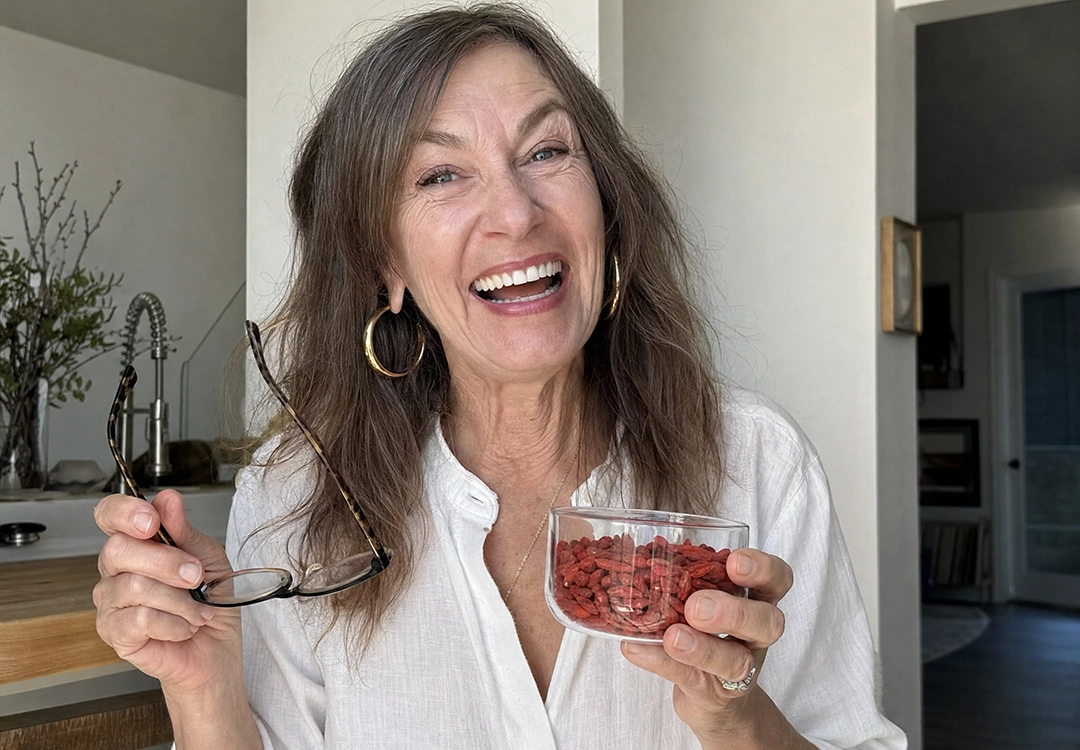
Twenty berries, hot water, two minutes, the same handful the study used. USDA Organic, third-party tested, and backed by a 60-day money-back guarantee. The only thing left to decide is whether to start tomorrow morning.
Get My Goji Berries →
6
Twenty berries. Hot water. Two minutes.
Drop them in a cup, pour the water over, let them plump, drink it, and eat the soft berries at the bottom. Not a tea person? Eat them by the handful, or scatter them over oatmeal or yogurt. No scoop, no capsule, no rulebook, just the kind of habit still going at week twelve instead of week two.
7
Cheap goji soaks up whatever it was sprayed with
Dried fruit concentrates everything: the nutrients and the field runoff alike. Most of what's on the shelf is fumigated, oven-blasted at a heat that wrecks the very pigment you're buying it for, then left to go stale. When you eat this every morning for your eyes, "organic" stops being a label and becomes the point: USDA Organic, third-party tested, recent harvest. This is not the place to save four dollars a bag.
8
If you watched a parent lose the center of their world, you've already done the math
You remember the way they stopped finding your face in a room. The card games they gave up. The "I won't be able to see it anyway" that ended every plan. And somewhere in the back of your mind, you've been quietly counting the years until it's your turn. This is the thing you can do about that math: a handful every morning, starting now, while the center still works and the scan still says "early."
9
You can wait on the next scan. Or you can do something in the months between.
There's the version where you wait six months and hope the next scan looks like the last one. And there's the version where, whatever it says, you spent those months feeding your eyes the exact pigment a university study showed is built to go up. Twenty berries is a strange place to take back control. It's also the only place that's yours.